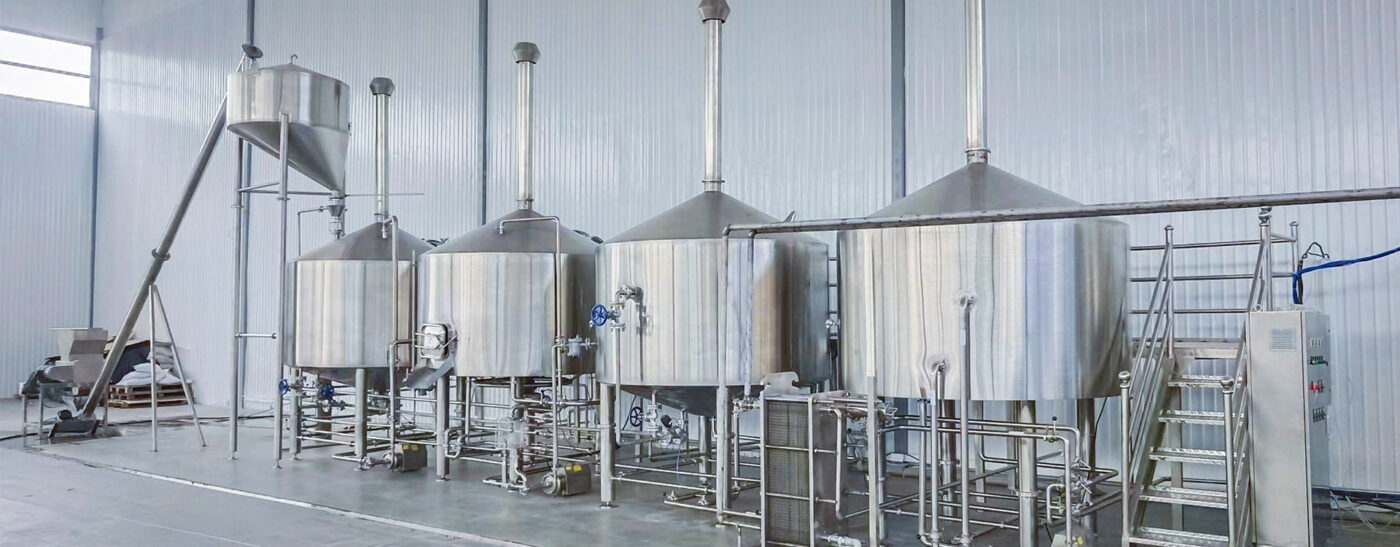
Yes. A turn-key brewery can support future growth when the first installation is sized around production stages rather than opening-day output alone. Brewers Association benchmarking has shown large differences by scale: 2015 data reported median electricity use of 46 kWh/bbl for microbreweries versus 21 kWh/bbl for regional breweries, while median water use fell from 7.4 to 5.0 bbl/bbl. A brewery planning to move from 5,000 to 10,000 bbl/year therefore needs more than extra tanks. Cellar space, refrigeration, water, steam, piping, electrical supply, packaging capacity, and controls must all have a practical expansion route.
A turn-key project starts to support growth before stainless steel reaches the site. Suppose a brewery opens with a 10 bbl system and produces 30 bbl per week. At 50 operating weeks, that equals roughly 1,500 bbl/year before losses. Moving toward 3,000 bbl/year can require twice the weekly cellar movement without replacing the hot side, provided enough brew turns, fermentation volume, labor hours, and utilities are available.
The first calculation should therefore connect annual packaged volume with brew frequency. A 10 bbl Brewhouse running 3 brew days per week and 2 turns per day has a theoretical hot-side rate of 60 bbl per week. At a hypothetical 93% transfer yield, about 55.8 bbl reaches fermentation. Over 50 brewing weeks, that is about 2,790 bbl entering the cellar, before fermentation, transfer, and packaging losses.
That number alone cannot describe real capacity because beer remains in fermentation much longer than it remains in the brewhouse. A 14-day ale occupies tank space for roughly two weeks; a lager may remain in a vessel for 21–35 days. A brewery producing 40 bbl each week with an average 14-day cellar cycle needs around 80 bbl of working fermentation volume simply to keep the schedule moving.
Tank count should follow beer residence time, not only brewhouse size. Moving from a 14-day average cycle to 21 days raises required fermentation occupancy by 50% at the same weekly production rate.
Headspace also changes the calculation. A nominal 20 bbl fermenter is not necessarily a 20 bbl working vessel for every recipe. If production planning assumes 90% usable volume, the working figure becomes 18 bbl. Five vessels provide about 90 bbl, while eight provide 144 bbl. That difference can postpone a larger brewhouse purchase because the existing hot side can operate more turns while the cellar absorbs the added beer.
Once tank capacity increases, refrigeration becomes the next engineering question. Fermentation cooling, crash cooling, bright tanks, cold rooms, and process water can all draw from the refrigeration system at different times. Adding four fermenters may appear simple on a floor plan, but an existing chiller selected for six tanks may not have enough capacity when several vessels require cooling during the same production period.
A staged turn-key design can prepare glycol headers, valve stations, pump capacity, pipe routes, electrical space, and physical locations for another chiller before expansion begins. The initial brewery does not need to purchase every future refrigeration component. It needs connection points that reduce the amount of installed equipment that must later be removed or rebuilt.
Water deserves the same treatment. Brewers Association material citing brewery water-use data reports a sample of N=211 with water-use ratios ranging from 3.26 to 7.44 liters of water per liter of beer in 2010, with a reported 10% improvement across the referenced data. At 10,000 liters of finished beer, a ratio of 4:1 represents about 40,000 liters of total water use; at 7:1, it becomes 70,000 liters.
Higher production therefore affects incoming water, hot-water storage, cleaning, floor drainage, and wastewater at the same time. Installing two more fermenters without checking cleaning-water demand can move the restriction from fermentation volume to CIP scheduling. A brewery that previously cleaned two vessels in a shift may need enough hot water, chemical circulation, return capacity, and staff time to clean four as weekly output rises.
| Planning area | Initial production example | Expansion question |
|---|---|---|
| Weekly beer to cellar | 30 bbl | Can the system reach 45–60 bbl? |
| Fermentation cycle | 14 days | What happens at 21–35 days? |
| FV working volume | 90 bbl | Is 135–180 bbl physically possible? |
| Water ratio | 4 L/L | Can supply and drainage handle 6 L/L? |
| Brew turns | 1 per day | Can labor and utilities support 2? |
| Packaging | 20 bbl/day | Can it reach 30–40 bbl/day? |
Utilities also become more economical per barrel as production rises, although the result depends heavily on brewery type and process. Brewers Association energy guidance gives an industry reference range of about 12–22 kWh of electricity per barrel and 1.3–1.5 therms of thermal energy per barrel. Equipment selection should therefore consider both installed capacity and consumption per unit of packaged beer.
Steam or electric heating illustrates the connection. If a brewhouse is expected to move from one turn to two turns per day by 2028, the heating system has to recover fast enough between batches. A kettle may have enough nominal volume, yet slow hot-liquor recovery can add 30–60 minutes between turns. Across 200 double-brew days, even 30 minutes represents 100 production hours.
Packaging can create a similar limit later in the process. A brewery producing 50 bbl per week only needs about 10 bbl/day of packaging capacity when spread over five days. At 100 bbl per week, the same line either operates twice as long or receives a throughput upgrade. Cans, kegs, labels, date coding, conveyors, compressed air, CO₂, cold storage, and finished-goods space must increase with the line.
For that reason, a useful turn-key specification separates equipment that must be installed at opening from infrastructure that only needs to be expansion-ready:
-
Provide cellar floor space for the planned second tank group; size main pipe routes so later branches can be added; reserve electrical-panel positions and control I/O; provide sanitary connection points for future CIP and glycol circuits; keep an installation route large enough for future vessels; and leave packaging utilities accessible rather than placing permanent equipment across the planned expansion area.
Automation becomes more useful as vessel count rises. A brewery with 6 fermenters may be manageable with relatively simple local controls, while a cellar expanded to 18 vessels creates far more temperature readings, valve states, cleaning records, alarms, and transfer steps. Reserving 20–30% additional control-panel and I/O capacity during the first installation can cost less than replacing a full enclosure after several production stages.
Physical space is only one part of expansion. A location for four future tanks has limited use if glycol pipes, electrical supply, drainage, CIP connections, or control points cannot reach them without stopping production.
Standardization also matters once the original brewery and later additions operate together. If a 2026 installation uses one valve type, temperature-sensor format, manway design, spray device, and fitting standard, adding vessels with compatible parts reduces the number of spares technicians must keep. Maintenance staff also work with familiar assemblies instead of learning a different arrangement for each expansion phase.
Process consistency benefits from the same approach. Two nominally equal fermenters can behave differently when cooling-zone area, cone geometry, insulation, probe position, or spray coverage differs. For a brewery adding 50% more cellar volume, purchasing to a documented vessel specification gives production staff a better chance of keeping fermentation temperature, cleaning cycles, carbonation, and transfer procedures consistent across old and new tanks.
Documentation therefore has a practical role long after commissioning. A complete turn-key package should retain P&IDs, equipment layouts, electrical drawings, utility requirements, valve schedules, instrument lists, manuals, spare-parts records, and control descriptions. When a brewery expands in 2028 or 2030, engineers can compare proposed equipment with recorded pipe sizes, electrical capacity, refrigeration distribution, and existing connection points rather than surveying the entire plant again.
Expansion planning also needs room for changes in product mix. A brewery producing 80% ales with 14-day tank occupancy may later increase lager production. If average occupancy rises from 14 to 21 days while weekly brewing stays unchanged, required cellar volume rises from two weeks of production to three. At 60 bbl per week, the difference is approximately 120 versus 180 bbl of occupied production volume.
Building size can then become more restrictive than equipment output. Four 40 bbl fermenters add 160 bbl of nominal capacity, but the project also needs vessel spacing, service access, overhead clearance, drainage, piping, and a safe route for installation. Reserving a future cellar zone during the first layout is often more practical than relocating operating tanks several years later.
Turn-key supply works well for growth when the brewery is treated as one connected production facility rather than a brewhouse surrounded by separate machines. The 2016 Brewers Association benchmarking update reported 29 regional-brewery participants with median electricity use of 21 kWh/bbl, compared with 35 microbrewery participants at 46 kWh/bbl. Scale alone does not produce those figures, but the gap shows why equipment use, utilities, production scheduling, and plant design need to be considered together.
A brewery expecting production to rise by 50%, 100%, or more should therefore specify future tank positions, utility connection allowances, control capacity, pipe access, packaging space, and documented equipment standards before the first commissioning. The strongest turn-key design is not the largest plant purchased on day one; it is a plant that can add production capacity without repeatedly rebuilding the systems already paid for.