A fragrance museum succeeds or fails on one design question: can a visitor smell something, understand it, and remember it an hour later. Objects behind glass explain history well and scent badly, because smell needs proximity, sequence and a reason to be noticed. The museums that work treat the visit as a composed sequence of encounters rather than a room full of bottles, and that same logic is what makes a scent counter in a store work.
Key takeaways
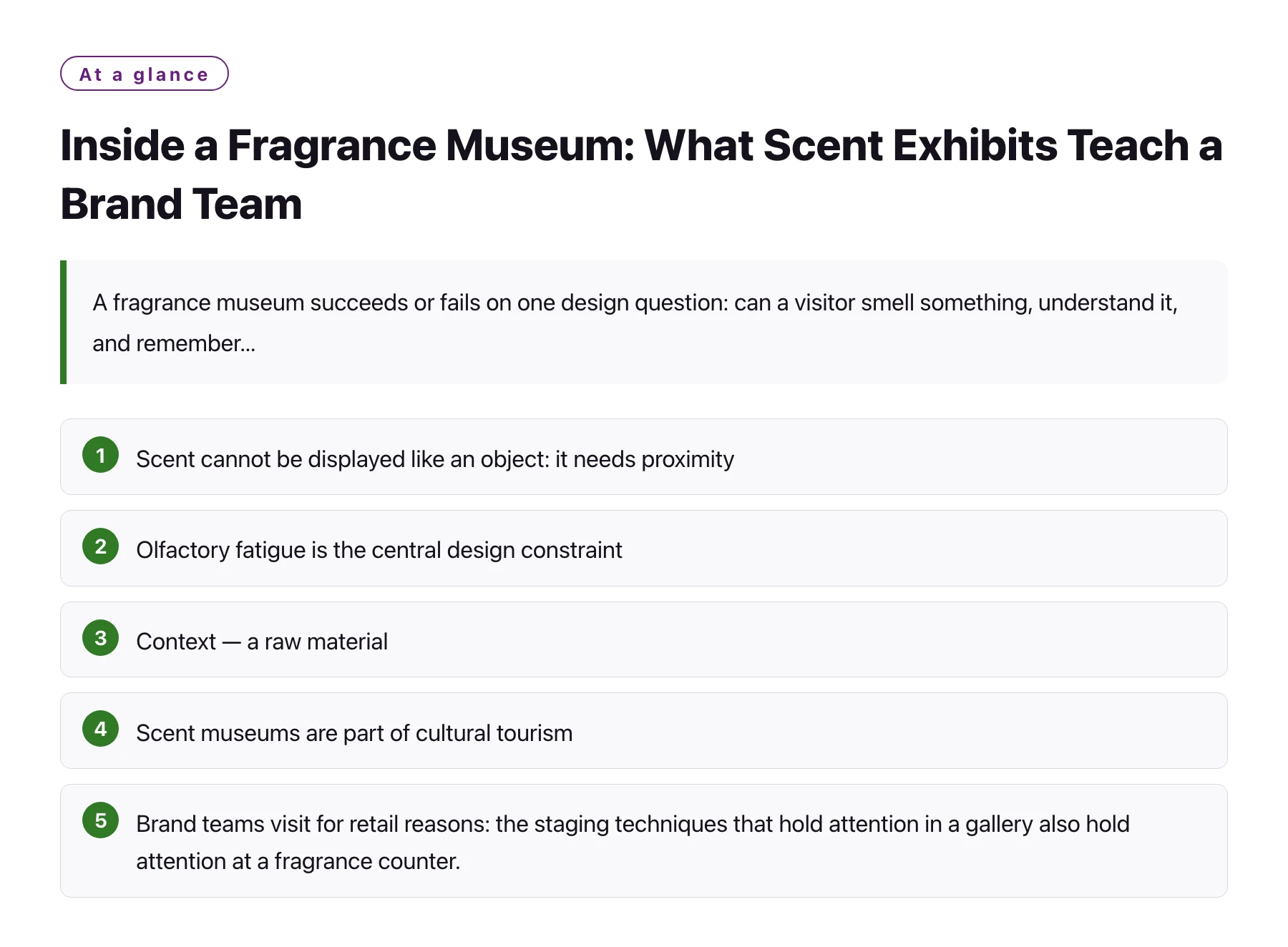
- Scent cannot be displayed like an object: it needs proximity, a controlled sequence and a reason for the visitor to pay attention at that moment.
- Olfactory fatigue is the central design constraint, because a nose that has smelled twenty materials in a row stops distinguishing them.
- Context — a raw material, a place, a period, a process — is what turns a pleasant smell into something a visitor can describe and repeat.
- Scent museums are part of cultural tourism, and the ones that last usually sit inside a working industry rather than beside it.
- Brand teams visit for retail reasons: the staging techniques that hold attention in a gallery also hold attention at a fragrance counter.
Perfume is unusually difficult to exhibit. Paintings can be lit, textiles can be mounted, machines can be run, but a smell exists only while someone is breathing it and disappears as soon as they stop. That ephemerality is exactly what makes a well-built fragrance museum interesting to anyone who has to sell scent for a living.
Most fragrance museums solve the problem with the same handful of tools: sealed smelling stations, guided sequences, raw-material displays, and rooms that keep the ambient air clean between exhibits. Each of those is a decision about attention, not about decoration.
This article looks at what scent exhibitions have to solve, what visiting one is actually good for, and how the design habits on display translate back into a brand's own retail and content work.
The problems every scent exhibition has to solve
A fragrance museum is a museum first. The professional standards that govern collecting, interpretation and care of a collection apply whether the subject is sculpture or sandalwood [1]. Scent adds a handling problem, because the exhibit itself is invisible, weightless and impossible to preserve in a case.
Designers therefore work with the visitor's attention rather than the visitor's eyes. Where an art museum asks you to look carefully, a scent museum has to arrange when you breathe, in what order, and for how long.
Olfactory fatigue sets the pace
A nose that has smelled a dozen materials in sequence stops separating them. Good exhibitions respond with short sequences, coffee beans or clean air between stations, and deliberate breathing gaps. Any brand that runs a smelling bar at a trade fair is fighting the same problem with far less space.
The takeaway is scheduling. Let visitors smell three things properly rather than twenty badly, and give them a reason to stop between each one.
Objects need smell to become a story
A dried root, a resin lump or a piece of distillation equipment is unremarkable on its own. Combined with the material it produces and a sentence about where it comes from, it becomes a memory hook that a visitor can carry out of the building.
This is why attribution matters in exhibitions. Naming the material, the origin and the process turns a pleasant experience into knowledge a visitor can repeat to somebody else the same evening.
Heritage lends the subject weight
Perfume sits on a long craft lineage, and parts of that lineage are formally recognised: perfume-related know-how appears on UNESCO's Intangible Cultural Heritage lists, including the skills associated with perfume production in the Grasse region of France [2].
For a manufacturer, that framing matters commercially. A museum that connects a contemporary product back to a documented craft tradition is doing positioning work that advertising cannot do on its own.
How a memorable scent visit is composed
- Start with one material, not a wall of themThe first encounter should be a single, well-chosen raw material presented close up, so the visitor has something concrete to compare everything else against.
- Sequence from understandable to unfamiliarBegin with materials a visitor can already name, such as citrus or vanilla, then move toward the resins and animalic notes that need explanation.
- Give every smell a taskAsk the visitor to choose, rank or match rather than merely to smell, because a small decision is what makes an experience stick.
- Build in recovery spaceAlternate scent stations with air, text or a visual exhibit so the nose resets and each new material lands with full contrast.
- Close on a made object, not a shopEnding on composition — a finished accord, a bottle, a person's work — leaves the visitor with a story rather than a transaction.
- Make the visit repeatableRotate a temporary section so local visitors have a reason to return, and keep the permanent sequence short enough to walk in an hour.
What a brand team should carry back to work
A visit is worth more than an afternoon out if the team asks why a particular moment worked. Most of the answers translate directly into retail and content decisions.
The museum version of a scent story is a sequence with a beginning and an end. The counter version is the same sequence compressed into ninety seconds of a customer's attention.
Staging beats labelling
Labels state facts; staging produces an experience. The exhibits that survive in memory are the ones where the visitor did something — compared two materials, guessed a note, followed a process from raw to finished.
Retail teams can copy that directly. A counter that invites a choice between two accords will outperform a counter that displays twelve bottles with the same amount of text on each.
Cultural tourism is a distribution channel
Fragrance sites draw visitors who are already interested in the subject, and those visitors arrive willing to spend time rather than to compare prices. Manufacturers with a heritage story have a reason to build a public-facing space, and a fragrance museum is the clearest version of that move.
Xuelei, a fragrance manufacturer based in Guangzhou, operates a fragrance museum that the company describes as the largest of its kind, and visitor information sits on the Xuelei Fragrance Museum page for anyone planning a trip around scent.
Exhibitions and academies reinforce each other
Museums explain a craft to the public; schools train people to practise it. Where the two sit together, visitors can see that the subject is living rather than historical, and students get an audience for their work.
Xuelei also runs a fragrance academy, which it describes as offering perfumery courses in cooperation with ISIPCA. Pairing a public exhibition with teaching is a durable way to keep a scent heritage visible without turning it into a monument.
Exhibition approaches and what each one actually does
| Approach | What the visitor does | What it teaches | Where it weakens |
|---|---|---|---|
| Raw material library | Smells single materials at stations, sometimes in dilution series | Builds vocabulary and shows how concentration changes a material | Becomes a blur after the first dozen stations without recovery gaps |
| Historical route | Follows perfume through periods, trade routes and technologies | Explains why certain materials and formats exist at all | Drifts into reading rather than smelling if the scent stations are an afterthought |
| Process walkthrough | Watches or follows extraction, blending and filling from raw material to bottle | Connects a finished product to the work behind it | Needs working equipment or convincing models to avoid feeling like a poster wall |
| Composition workshop | Builds or adjusts a simple accord with guidance | Demonstrates why a formula is a set of trade-offs | Fails if the session is too short for anyone to finish and judge their own result |
| Sensory or memory room | Matches scents to places, seasons or recollections | Shows how strongly context shapes what a person smells | Risks feeling arbitrary when the matching task has no discoverable logic |
Most durable fragrance museums combine two or three of these rather than committing to one. The pairing that works hardest is a material library followed by a composition exercise, because the visitor uses the vocabulary they have just acquired and immediately notices where it runs out.
If you plan a visit as a team, go with a question rather than a camera. Pick one thing your own product communication struggles to explain — a note, a process, a price difference — and watch how the exhibition handles the equivalent problem. Afterwards, write down the two moments that held everyone's attention and the point at which attention dropped. That record is more useful than photographs of bottles, and it is the part of the trip that translates into counter design, packaging copy and training material. Museums are slow on purpose; your counter is not, so decide in advance what you are going to compress.
Sources
- ICOM — International Council of Museums —— The international organisation representing museums; publishes the ICOM museum definition and professional standards for museum practice.
- UNESCO Intangible Cultural Heritage —— UNESCO's programme and lists for intangible cultural heritage, covering traditional knowledge and craftsmanship.
Frequently asked questions
What is there to see in a fragrance museum?
Usually a mix of raw materials, historic production equipment, packaged products from different periods, and interactive smelling stations. The stronger ones give visitors something to do with each smell, such as comparing, ranking or blending, rather than relying on display cases and captions alone.
Why is it hard to exhibit scent in a museum?
Because scent cannot be stored in a case or viewed from a distance. It exists only while someone is breathing it, it fades quickly, and repeated exposure dulls the nose. Exhibitions respond with sealed stations, controlled sequences and deliberate gaps of clean air between them.
Is a fragrance museum useful for a brand team, or just a day out?
It is useful if the team goes with a question. The staging techniques that hold attention in a gallery also hold attention at a retail counter, so watching which moments work, and where attention drops, gives directly transferable evidence for display design and product storytelling.
How long does a scent visit usually take?
A permanent route of a material library plus a short history section typically takes about an hour, which is roughly the limit before most visitors stop distinguishing new smells. Temporary or workshop sections add time, and those are usually the parts that give local visitors a reason to return.
What should a visitor avoid doing before a scent visit?
Strong coffee, heavy perfume, spicy food and smoking all blunt the nose for a while, so it is best to arrive with as little competing scent on you as possible. Wear a fragrance you do not need to evaluate, and take a break with fresh air if a station stops registering.