How Character Backstories Shape AI Sex Chat
A backstory is not decoration on a card; it is the seed the conversation grows from. Two characters with identical tags and different origins will answer the same message differently, and the difference shows up quickly in vocabulary, in pacing, and in what each one treats as worth noticing.

Key takeaways
- A backstory constrains a character: it sets vocabulary, priorities and what the character can plausibly know.
- The platform's framing is customizable characters with their own personalities and interaction styles, which is a description of seeds rather than of looks.
- Backstory effects are visible inside five messages, so a test costs about 2.5 minutes rather than a whole evening.
- Two three-session comparisons take 1.5 hours each at half an hour a session — 3.0 of the 8.0 hours in a month of sixteen visits.
Why a backstory is a constraint rather than a costume
Read a card's setup text and you are reading a set of limits. An origin story tells a character what it does for a living, which fixes the vocabulary it reaches for. A stated goal decides what it pushes toward when a conversation stalls. A time and a place decide which references feel natural and which feel imported from nowhere.
Those limits are the reason backstories improve sessions. A character with constraints answers a question in a particular way, and particularity is what makes a reply feel like it came from someone rather than from a template. A character with no constraints has nothing to draw on, so it answers generically no matter how good the opening line is.
The platform's own description of its characters points in the same direction: customizable characters with their own personalities, appearances and interaction styles. Personality and interaction style are not properties of a picture; they are properties of a setup, and they are what a reader is really choosing between.
Where the backstory surfaces in a session
The first message shows the character's tone, which usually follows from its origin. The third message shows what it contributes without being asked, and a well-seeded character adds something consistent with its own history rather than a generic prompt back to you.
The fifth message is where recall becomes visible. Mention a detail from the setup — a place, a job, a name that appeared in the backstory — and see whether the character treats it as its own. If the detail vanishes, the setup is likely thin or poorly matched to how the card behaves.
Longer storylines test a fourth thing: consistency. A character with a clear origin stays recognisable across sessions, because each session starts from the same constraints rather than reinventing a personality in the moment.
A fifth check saves time later. Ask the character something the setup gives it no reason to know, and notice whether it admits the gap or invents an answer. A card that improvises consistently is workable; one that contradicts its own setup inside a single session will do the same thing in a longer storyline.
| Element in the setup | What it seeds | One-session test |
|---|---|---|
| Origin or occupation | Vocabulary and what the character notices first | Ask about something inside that field |
| A stated goal | Initiative and what it pushes toward | Let the conversation idle and see if the card advances its own agenda |
| Time and place | Reference points and pacing | Mention a location from the setup and watch how it is used |
| Relationships named in the setup | Tone when that name comes up | Refer to the name indirectly and check for a change in register |
| Gaps in the setup | Improvisation | Notice whether invented detail stays consistent fifteen messages later |
Worked example: costing a backstory comparison
Comparing two characters properly is a three-session job per card, because one session shows tone and three show consistency. At half an hour a session that is 1.5 hours for each candidate, so a straight comparison of two takes 3.0 hours.
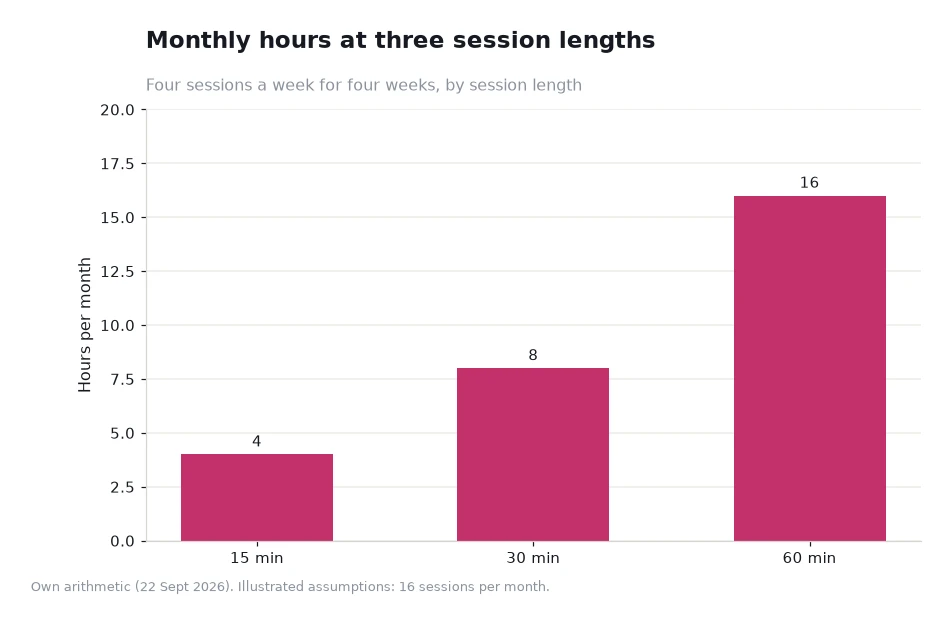
Now place that against a month. Sixteen sessions — four a week for four weeks — is 4.0 hours at 15 minutes, 8.0 hours at 30 minutes and 16.0 hours at 60. Two full comparisons consume 3.0 of the 8.0 hours in the middle pattern, which is about 38% of the month, leaving 5.0 hours for whichever character wins.
Shorten the test if the month is short. At a quarter of an hour a session the whole month is 4.0 hours, and one three-session comparison costs 0.75 hours, roughly a fifth of it. The arithmetic scales cleanly, which means the comparison method does not have to change when the clock does.
Reading the setup before the first message
The setup text is the most informative thing on a card, and it costs nothing to read. Start with the description at https://crushon.ai/ai-sex-chat, which frames the category around Sex AI companions that adapt to your personality and remember your preferences, then read each candidate's setup with three questions in mind: what does this character want, what does it know, and what would it never say?
Crushon's cards put that setup beside a tag row and a creator credit, and the three together are usually enough to predict which of two candidates will suit you. Where they disagree — a promising tag with a thin setup — trust the setup, because the setup is what the conversation will be built from.
Two further pages help when a comparison is inconclusive. The character search page finds alternatives by keyword when a setup is close but not quite right, and the AI chat blog explains how prompting interacts with the setup a character was built on.
A setup is also the one part of a card that cannot be guessed from a thumbnail, which is why reading it rewards a slower first pass than the counters do. Ten setups read carefully is a better use of ten minutes than twenty openings skimmed, because only one of those two habits tells you what a session will actually be like.
Frequently asked questions
Does a longer backstory always mean a better character?
No. Length is not the point; specificity is. A short setup with a clear origin and goal constrains a conversation more usefully than a long one full of adjectives.
How quickly can I tell whether a setup works?
Five messages, which is about 2.5 minutes. Tone appears in the first reply, contribution in the third and recall in the fifth.
What should I compare two candidates on?
The same three sessions each: tone, consistency and recall. At half an hour a session that is 1.5 hours a card and 3.0 hours for a straight comparison.
Choose the setup, then the card
Choose the setup, then the card. Read the setup first, spend three sessions testing it, and keep the card whose constraints you actually enjoy working inside. A backstory that matches your pace is worth more than a tag row that matches your mood, because only one of the two is still there in the fifth session.
If two candidates are close, keep the one whose setup you can describe from memory. A backstory you can summarise in one sentence is one you will still be working from by the fifth session, while a setup you have to reread every time slowly stops shaping the conversation at all.
Data and sources: the character description and setup wording published on CrushOn.AI[1], read 22 Sept 2026. The 16-session month, the 2.5-minute test and the 1.5-hour audition are illustrative assumptions, not platform data. This article is for readers of adult age, 18 and over.