How Modular Docking Expands Mobile Robot Applications

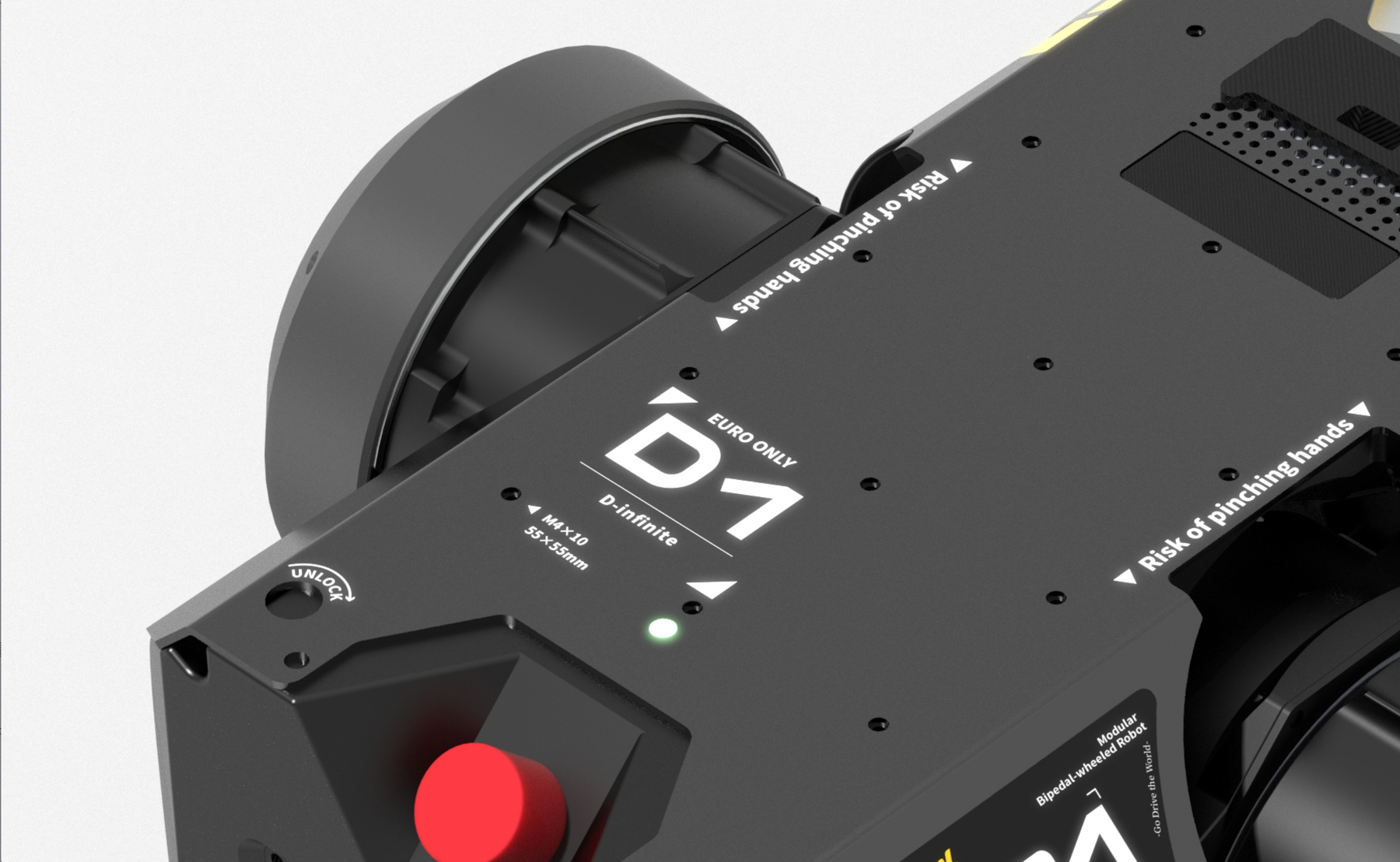
D1 Robot EU Version for Modular Robotics Labs

An embodied intelligent robot combines cameras, depth sensors, tactile devices, IMUs, microphones, and AI processors to perceive and interact with physical environments. Current systems integrate 10–30 sensor units, process hundreds of gigabytes of data daily, and require edge computing platforms delivering 10–275 TOPS for real-time inference. Selecting hardware requires balancing sensing accuracy, latency, power consumption, and model size across applications such as manipulation, navigation, and human interaction.

The choice of sensors determines how accurately a robot can understand the physical world. Unlike traditional automation systems that rely on fixed instructions, embodied robots must collect continuous information from changing environments. A humanoid platform may use stereo cameras, LiDAR, force sensors, tactile arrays, and inertial systems together because each sensor provides different information.

A camera can recognize an object, but tactile feedback can determine whether the robot is holding it correctly.

Vision remains the primary sensing method because cameras provide rich semantic information at relatively low cost. Modern RGB cameras used in robotics commonly range from 2 megapixels to 12 megapixels, with frame rates between 30 and 120 frames per second. A single 12 MP camera operating at 60 FPS can generate more than 1 GB of raw image data per second before compression, creating significant processing requirements.

Depth sensing improves spatial understanding. Stereo cameras estimate distance through image differences between two lenses, while ToF sensors measure the return time of infrared light. Commercial ToF modules usually provide centimeter-level accuracy within 5–10 meters, while LiDAR systems can achieve millimeter-to-centimeter accuracy depending on range and environment.

Sensor type Typical specification Main usage
RGB camera 2–12 MP, 30–120 FPS Object recognition, scene understanding
Depth camera 0.1–10 m range Grasping, obstacle detection
LiDAR cm-level accuracy Mapping and navigation
IMU 100–1000 Hz update rate Motion estimation
Tactile sensor sub-mm to mm resolution Contact control

The information collected by visual sensors is often insufficient for physical interaction, which leads robots to incorporate touch and force measurement. Robotic hands used in research platforms may contain 100–1000 sensing points to measure pressure distribution, contact location, and grip force. Studies on dexterous manipulation have shown that tactile feedback can improve object handling success rates by more than 20–40% compared with vision-only systems.

Force-torque sensors are widely installed at robot wrists and joints. Industrial-grade six-axis force sensors typically measure forces from several newtons to thousands of newtons with sampling frequencies between 100 Hz and 2 kHz. These sensors allow robots to adjust contact force during assembly, polishing, or object placement.

The growing demand for physical interaction has also increased interest in integrated robotic platforms such as a multimodal mobility robot that combines environmental perception, movement control, and AI-based decision systems. These systems often combine cameras, IMUs, microphones, and computing modules into a compact architecture rather than using isolated components.

Audio sensing provides another information channel for embodied intelligence. Microphone arrays allow robots to identify speech direction and environmental sounds. A four-to-eight microphone array can estimate sound location with several degrees of angular accuracy under suitable conditions. Modern voice interaction systems often process audio streams at 16–48 kHz sampling rates, requiring additional computing resources when combined with visual models.

Sensor selection is closely connected with data processing requirements. More sensors do not always produce better performance because additional data increases synchronization requirements and software complexity. A robot equipped with four cameras, one LiDAR unit, and multiple tactile sensors may generate several terabytes of raw data during long-term operation.

Sensor design focuses on obtaining useful information while controlling data volume and energy consumption.

Because individual sensors provide incomplete information, embodied robots rely on sensor fusion algorithms. Visual-inertial systems combine camera images with IMU measurements to estimate position and movement. Research published between 2015 and 2025 has shown that visual-inertial odometry can reduce localization errors compared with camera-only methods, especially during rapid movement.

For autonomous navigation, SLAM systems combine LiDAR, cameras, and inertial data to build maps while estimating robot location. Modern SLAM approaches can achieve centimeter-level positioning accuracy in structured indoor environments. However, performance decreases when lighting, surfaces, or environmental conditions change, making multi-sensor integration necessary.

The sensor fusion process also affects computing architecture. Neural networks used for perception may require millions or billions of parameters. Object detection models can process camera input at more than 30 FPS on dedicated AI processors, while large multimodal models require significantly higher memory bandwidth.

Computing hardware determines whether sensory information can be processed quickly enough for physical interaction. Embodied robots usually use a layered computing architecture consisting of real-time controllers, edge AI processors, and high-level AI systems.

Low-level controllers handle motor commands, joint position control, and safety functions. These tasks usually require response times below 1 millisecond. Microcontrollers and real-time processors are preferred because stable timing is more important than large computational capacity.

Edge AI computing handles perception and local decision-making. NVIDIA Jetson platforms, Qualcomm robotics processors, and custom AI accelerators are widely used in research and commercial robots. Recent embedded platforms provide approximately 10–275 TOPS while maintaining power consumption between 5 and 100 watts.

Computing layer Hardware examples Processing requirement
Motion control MCU, RT processor <1 ms latency
Sensor processing FPGA, NPU 1–20 ms
AI perception GPU accelerator 20–100 ms
Large model reasoning AI server or advanced accelerator 100 ms–seconds

The increasing use of foundation models has changed computing requirements. Vision-language-action models connect visual input, language instructions, and robot movement. Models released between 2022 and 2025 often contain hundreds of millions to several billion parameters. Running these models locally requires efficient memory management, model compression, and hardware acceleration.

Model optimization methods reduce computing requirements. Quantization can reduce model precision from 32-bit floating point to 8-bit integer representation, reducing memory usage by around 50–75% in many applications. Pruning techniques remove unnecessary parameters and can improve inference speed by 20–60% depending on the model structure.

Power consumption remains an important limitation for mobile robots. A humanoid robot may consume several hundred watts during walking and manipulation. Computing systems can account for approximately 20–40% of total energy usage in AI-intensive tasks, depending on sensor configuration and model complexity.

Efficient robots require suitable computing capacity rather than maximum computing capacity.

Hardware selection varies according to application requirements. Warehouse robots usually prioritize reliable navigation and obstacle detection, using LiDAR, RGB cameras, and moderate AI processors. These systems commonly operate continuously for 8–24 hours and focus on predictable indoor environments.

Domestic robots require broader perception because household environments contain irregular objects and human interaction. A home service robot may combine RGB-D cameras, microphones, tactile sensors, and edge AI processors capable of running compact multimodal models.

Humanoid robots require the most comprehensive sensing and computing systems. They must maintain balance, understand instructions, manipulate objects, and interact safely with humans. Commercial humanoid platforms developed after 2020 commonly include dozens of sensors, high-performance GPUs, and custom software frameworks.

Future embodied robots are expected to use adaptive sensor activation and efficient computing methods. Instead of processing every sensor continuously, robots may increase sensing resolution only when tasks require additional information. For example, a navigation system may rely on low-power cameras during normal movement and activate depth sensing during complex manipulation.

The relationship between sensors and computing will continue to shape robot development. Better sensors increase available information, while improved processors allow robots to interpret that information faster. A practical embodied intelligent robot depends on the coordination of perception hardware, computing resources, and physical control systems rather than relying on a single component.