The EV Line-Up Landing in Australia in 2026
The Australian range is short, deliberate and easy to learn: two models on sale today and one waiting in the wings. The New G6 coupé SUV and the seven-seat X9 are available now, both on a full-domain 800V platform with a 10-80% charge in 12 minutes, while the L03 is listed as coming soon with registrations of interest open.

Key takeaways
- On sale now: the New G6 coupé SUV and the X9 seven-seat MPV, both with a 12-minute 10-80% charging window.
- Coming soon: the L03, listed with a register-your-interest path rather than a launch date.
- Published strategy points to five new models during 2026 and Navigation Guided Pilot from 2027.
- Range ceilings published so far are 525 km for the New G6 and 580 km for the X9, both WLTP.
What is on sale in Australia right now
The New G6 is described on the manufacturer's pages as an ultra smart coupé SUV, and the media line calls it the 2026 XPENG G6 smart coupe SUV. It publishes WLTP range of up to 525 km, the 12-minute rapid window on its 5C battery, a 0-100 km/h time of 4.13 seconds in AWD form, and two variants, RWD Long Range and AWD. Design details the site highlights are a fastback silhouette, a long front overhang and a full-width integrated light bar.
The X9 takes the opposite approach: an ultra intelligent seven-seat MPV with WLTP range up to 580 km, the same 12-minute rapid window, a 0-100 km/h time of 5.9 seconds and hardware aimed at comfort rather than speed, including active rear-wheel steering and dual-chamber air suspension with an AI chassis that reads the road ahead and adjusts damping. Its third row folds flat at the touch of a button, cargo space expands to 2554 L, and the submerged trunk design is described as fitting seven suitcases with all seats occupied.
What is still coming
The L03 is listed as coming soon, with the site inviting buyers to register their interest rather than quoting a date. That is a normal pattern for a new market: the model appears in the range listing first, and pricing and specification arrive through the configurator and dealer network as the launch approaches. Anyone with a firm timeline should register interest and let the dealer contact them, because nothing in the published material commits to a delivery month.
Beyond the individual models, the company's Australian news pages document a broader plan. A strategy announcement in July 2026 set out advanced Navigation Guided Pilot from 2027, five new models during 2026 and a growing sales and service network, published alongside the X9 launch in Melbourne. Quarterly results released in August 2026 reported a gross margin of 20.7% and overseas markets contributing 25% of first-half revenue, which is the financial context behind the local expansion.
| Model | Status | Published highlights |
|---|---|---|
| New G6 | On sale | 525 km WLTP, 12-minute 10-80%, five seats |
| X9 | On sale | 580 km WLTP, seven seats, rear-wheel steering |
| L03 | Coming soon | Register interest; no date published |
| New models | Planned for 2026 | Five in total, per the published strategy |
The technology programme behind the range
The model list is only part of the picture, and the company's news pages fill in the rest. A robotics business raised more than US$900 million at a post-money valuation above US$6.3 billion, the IRON humanoid robot has rolled off a new production line, the World Model Accelerator known as X-Cache is described as plug-and-play with a 2.7 times boost to inference speed, and the first mass-produced robotaxi unit left the line in May 2026. The site also lists Innovation areas covering the AI Car, AI Robot IRON, a flying car and the Turing AI chip.
None of that changes the boot space of the car you buy this year, but it does explain why the line-up is expanding rather than standing still. A manufacturer investing in autonomy, robotics and chips at that scale is building the software base that driver assistance features draw on later, which is the part of a modern car that improves after delivery rather than at the moment of delivery.
While the L03 timeline firms up, the practical move is to hold your place in the queue and stay in touch with a dealer. Registering interest costs nothing, and the same site lists the tools that make the rest of the process work: Build My XPENG for the configurator, Find a Dealer for the nearest sales point, Test Drive for bookings, Owner Connection for existing owners, Contact Us for general questions and Partner Recruitment for businesses. If your current car has another two years left in it, watching the range grow from a distance is a reasonable strategy, because the published plan suggests there will be more to choose from by then.
Worked example: what a switch costs to run
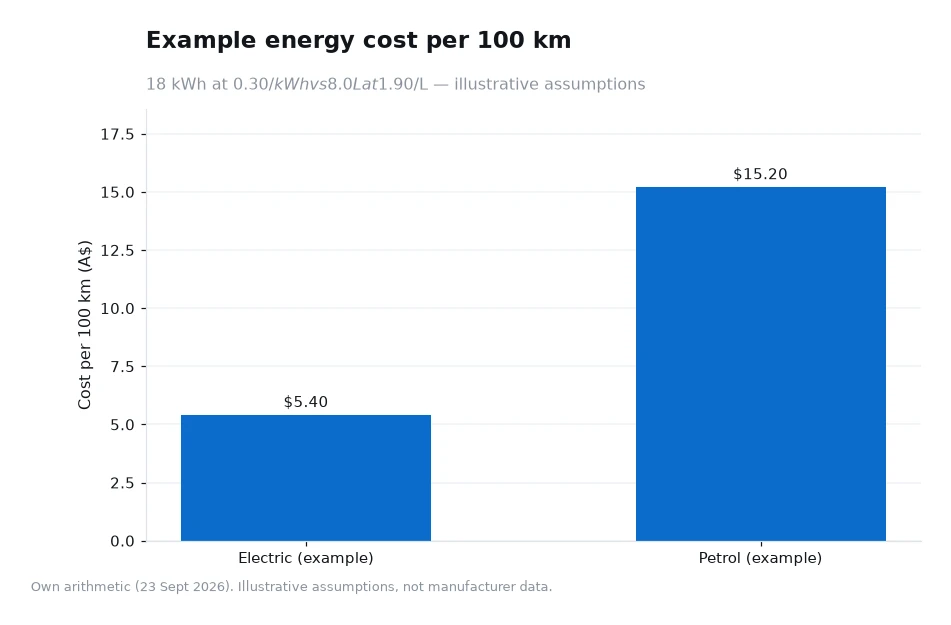
The chart alongside this section sets two illustrative assumptions side by side: an electric car using 18 kWh per 100 km with electricity at $0.30 per kWh, and a petrol SUV using 8.0 L per 100 km at $1.90 per litre. Multiplication gives the bars you can see: 18 times 0.30 is $5.40 per 100 km electric, and 8.0 times 1.90 is $15.20 per 100 km petrol. Neither figure is a quoted price; both are arithmetic on assumed inputs.
Now scale it to a household. Assume 20,000 km a year, which is 200 blocks of 100 km. The electric case costs 200 multiplied by 5.40, or $1,080, and the petrol case costs 200 multiplied by 15.20, or $3,040. The difference is 3,040 minus 1,080, which is $1,960 a year. Over five years at the same distance that becomes 5 multiplied by 1,960, or $9,800 - and because the assumptions drive the answer, rework it with your own tariff, your own fuel price and your own odometer before relying on it.
Frequently asked questions
How many models does the brand sell in Australia today?
Two are on sale: the New G6 coupé SUV and the X9 seven-seat MPV. A third, the L03, is listed as coming soon and takes registrations of interest.
When does Navigation Guided Pilot arrive?
The published Australian strategy, announced in July 2026, points to advanced Navigation Guided Pilot from 2027, alongside five new models during 2026 and a growing service network.
How to work through the line-up
Decide on seats first, then on shape. Five seats and a lower, sleeker body points to the New G6; seven seats and a boxier rear points to the X9. Both share the 800V platform and the 12-minute charging window, so the choice rarely comes down to charging speed. Read the XPENG electric cars australia model material for the five-seater, and compare it against the XPENG X9 pages for the seven-seater.
Then register your interest in the L03 if your timeline is longer, and book a test drive of whichever car exists today. Owner support, the app download and the dealer locator all live on the same XPENG ANZ site, which makes the research straightforward: one source, three models and a configurator that turns a shortlist into something a dealer can quote.
If both cars fit the budget, decide on the week rather than the weekend. Count how many times a year you carry more than five people, how often you carry long loads, and whether the second row has to take three child seats across it. The New G6 answers the ordinary weeks with a fastback body and 525 km of WLTP range; the X9 answers the exceptions with a third row, 580 km and cargo that expands to 2554 L.
Model status, range figures, charging windows and strategy details come from the manufacturer's Australian site and news pages, read 23 Sept 2026; WLTP range depends on conditions, and the running-cost arithmetic above is an illustrative example using the assumptions stated in the text rather than manufacturer data on prices.[1]